
Industry statistics
Construction Mistakes and Rework Statistics for 2026: What the Latest Research Shows
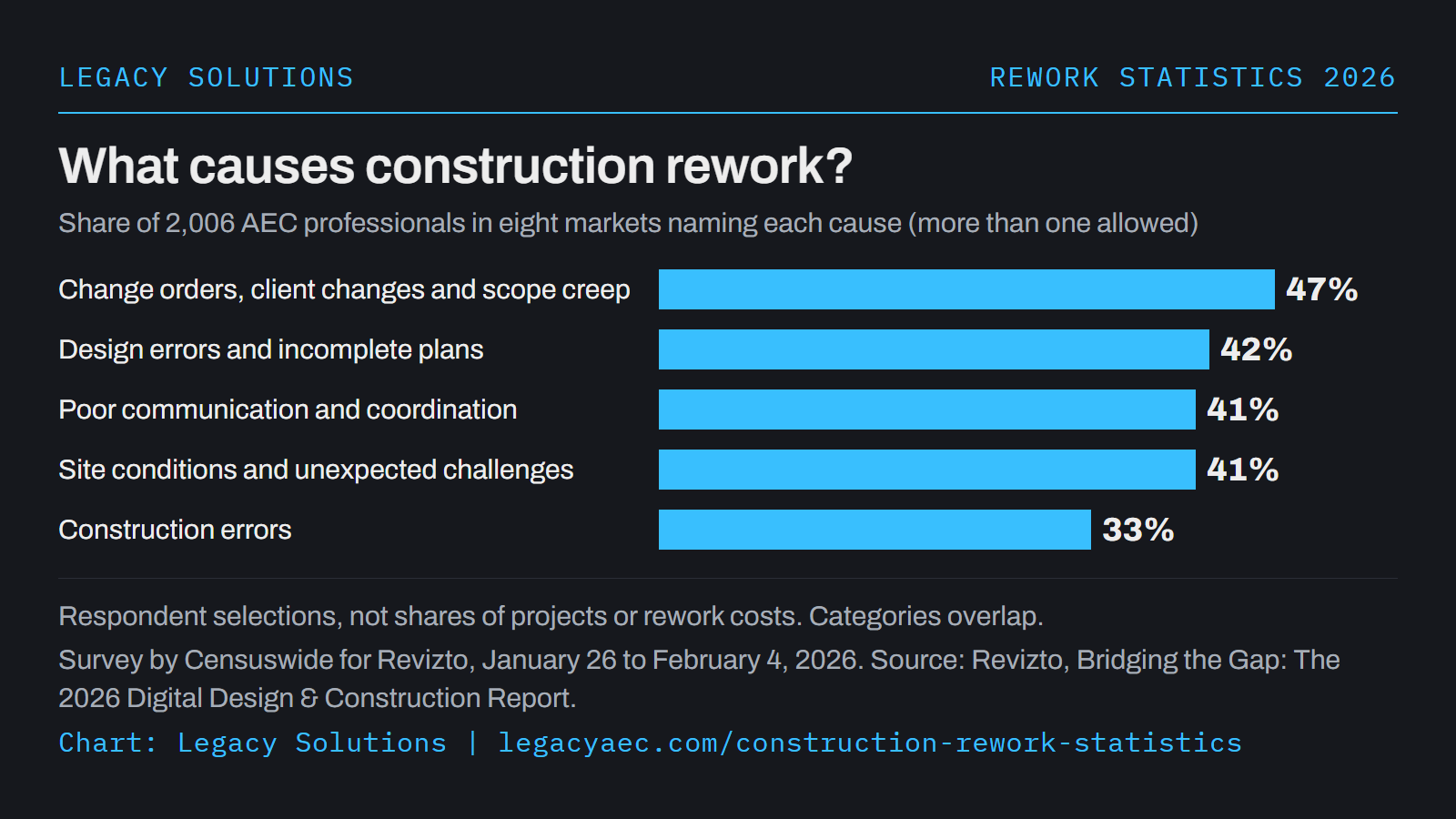
In Revizto's 2026 survey of 2,006 architecture, engineering and construction (AEC) professionals in eight markets, 41% named poor communication and coordination as a cause of rework, according to Revizto's published rework findings.
10 key rework statistics for 2026
- 01
47% of 2,006 AEC professionals surveyed in eight markets, including the U.S., named change orders, client changes or scope creep as a cause of rework, according to Revizto's 2026 survey. Revizto findings
- 02
42% of 2,006 AEC professionals surveyed in eight markets named design errors or incomplete plans as a cause of rework, according to Revizto's 2026 survey. Revizto findings, design errors
- 03
41% of 2,006 AEC professionals surveyed in eight markets named poor communication and coordination as a cause of rework, according to Revizto's 2026 survey. Revizto rework findings
- 04
41% of 2,006 AEC professionals in Revizto's 2026 survey named site conditions as a cause of rework, down from 53% in Revizto's 2025 survey. Revizto rework findings, site conditions
- 05
Two in three of 1,728 construction professionals surveyed by PlanRadar in Europe, the Middle East and Asia-Pacific in January 2026 said mid-project changes lead to budget overruns on many or most of their projects. PlanRadar report, page 9
- 06
One in four of 1,728 construction professionals in PlanRadar's January 2026 survey, which did not include the U.S., estimated that delayed approvals typically add more than a month to project timelines. PlanRadar report, page 8
- 07
36% of respondents whose approvals were almost always late reported project delays of more than a month, compared with 16% of those whose approvals were rarely late, in PlanRadar's January 2026 survey of 1,728 construction professionals. PlanRadar report, approvals comparison
- 08
0.38% of contract value was the average recorded cost of field rework before completion across one contractor's projects, in Peter E. D. Love's study in the Journal of Construction Engineering and Management (January 2026). Love (2026), DOI
- 09
37% of 10,176 U.S. homeowners surveyed by Houzz who renovated in 2025 exceeded their planned spending, according to the 2026 U.S. Houzz & Home Study. Houzz study, page 12
- 10
About $65 billion was FMI and PlanGrid's modeled estimate of total U.S. rework spending for 2018, based on rework at 5% of construction spending; it is a historical estimate, not a current total. FMI and PlanGrid report, page 19
Each figure keeps its source, population and year in the sentence. Each number is a link to that statistic: copy it to send readers straight to the figure.
What causes construction rework in 2026?
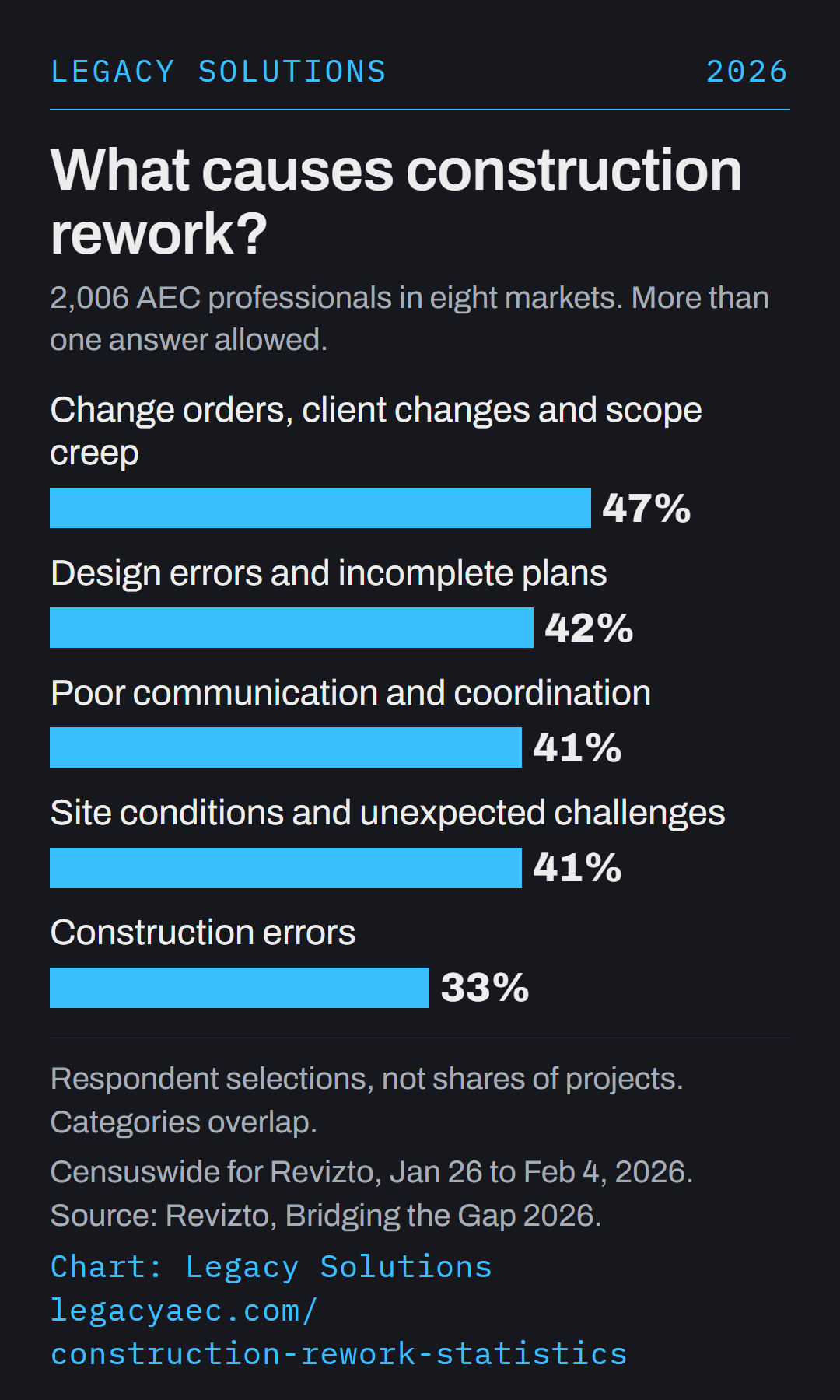
Revizto commissioned Censuswide to survey 2,006 AEC professionals across eight markets, including the United States, from January 26 to February 4, 2026. The sample emphasized senior leaders and larger businesses. Respondents could choose more than one cause, so the shares add up to more than 100%. Survey methodology (Revizto, May 7, 2026).
For a project team, the next question is where information loses alignment: when a client requests a change, when a design revision is issued, or when the field team needs a decision. Tracking that handoff gives a firm a more specific problem to investigate than simply labeling the outcome "rework."
How much does construction rework cost?
A useful cost figure starts with what was counted. Physical corrections before completion, later repairs, redesign and administrative time need not appear in the same accounting category.
Recorded field rework costs from one contractor
Peter E. D. Love's study, Quantifying the Costs of Field Rework in Construction, found average actual precompletion rework costs of 0.38% of contract value across one contractor's projects. Adding estimated postcompletion corrections raised the average to 0.76%.
The contractor's quality managers assumed later corrections cost roughly as much as precompletion rework; postcompletion cost records were unavailable. These figures describe that contractor's projects. They were checked against ASCE's published summary of the study. ASCE summary; original paper (DOI).
The historical $65 billion estimate
FMI and PlanGrid's Construction Disconnected report modeled roughly $65 billion in total U.S. rework spending for 2018, using an assumption that rework represented 5% of construction spending. Within that total, it attributed about $31.3 billion to poor data and communication. Report, pages 19 and 20.
The survey included 599 construction industry leaders, of whom 500 were in the United States. These historical estimates are not a measured 2026 loss and are not directly comparable with one contractor's recorded field correction costs. Survey demographics, page 4.
How do project changes and late approvals affect delivery?
PlanRadar surveyed 1,728 professionals in 14 countries across Europe, the Middle East and Asia-Pacific in January 2026; the United States was not included. PlanRadar methodology, page 5.
Its approval comparison found 36% reporting delays of more than a month when approvals were almost always late, versus 16% when lateness was rare. These are reported associations, not proof of causation.
For teams managing change requests, a useful review starts with the decision record: who needs to respond, by when, and what work depends on that response. A request marked "pending" says little about its consequences unless those dependencies are visible.
Why do home renovations go over budget?
Houzz's 2026 study included 10,176 U.S. homeowners who renovated their primary residences in 2025. The survey ran from January through March 2026 and was weighted to represent Houzz users. Houzz methodology, page 42.
| Reason for overspending | Share selecting it |
|---|---|
| Products or services cost more than anticipated | 52% |
| More expensive products or materials were chosen | 35% |
| The project proved more complicated than expected | 32% |
| Scope or design changed | 31% |
| Unexpected construction issues emerged | 22% |
These are reasons given by over-budget respondents, not construction defect rates. Houzz study, page 12.
For a homeowner discussing an overrun, the useful distinction is whether the additional spending came from a new choice, an unexpected condition, an estimate that missed something, or work that required correction.
AI and construction coordination in 2026
In PlanRadar's 2026 survey, two-thirds of respondents using central digital tools with integrated AI reported saving at least two hours a week per project on administration and coordination. This measures reported time savings, not rework reduction. PlanRadar report, page 20.
Revizto's May 2026 release, drawing on 600 CIOs in the U.S., UK, Europe, Australia and the Middle East, identified regulatory uncertainty (24%) and limited digital skills (23%) as the leading barriers to gaining value from AI. Revizto's AI-readiness findings.
For firms evaluating these tools, keep the outcomes separate. Less time spent finding information is one result; fewer corrections onsite is another. A credible claim about reducing rework needs evidence from the work itself, with a consistent definition and a meaningful comparison period.
What the research means for engineering firms and their clients
These studies offer different views of project performance. Our editorial takeaway is to use them as prompts for clearer questions rather than combine them into a single industry failure rate:
- Before a project starts: What is included in the scope, which decisions remain open, and which assumptions need checking?
- When something changes: Who approves it, and how will its cost and schedule implications be recorded?
- When information is issued: How will the team identify the current drawings and communicate revisions?
- When corrections are needed: How will the reason and cost be documented for future learning?
Engineering firms can also use these questions to explain their work to prospective clients. Service pages and case studies can describe responsibilities, coordination processes and the firm's actual role in completed projects. Claims about money saved or rework avoided should be supported by project records.
Sources, AI disclosure and corrections
- Revizto, Bridging the Gap: The 2026 Digital Design & Construction Report. Survey by Censuswide of 2,006 AEC professionals in eight markets, January 26 to February 4, 2026. Report page; rework findings; implementation findings; release, May 7, 2026.
- PlanRadar, Managing Project Changes in the Age of AI (survey report). 1,728 construction professionals in 14 countries in Europe, the Middle East and Asia-Pacific, January 2026. Report (PDF).
- Peter E. D. Love, Quantifying the Costs of Field Rework in Construction. Journal of Construction Engineering and Management, vol. 152, no. 1 (January 2026). DOI 10.1061/JCEMD4.COENG-17026.
- Houzz, 2026 U.S. Houzz & Home Study: Renovation Trends. 10,176 U.S. homeowners who renovated in 2025, surveyed January to March 2026. Study (PDF).
- FMI and PlanGrid, Construction Disconnected (2018). 599 construction industry leaders, 500 of them in the U.S. Report (PDF).
This article compiles existing research; Legacy Solutions did not conduct the underlying studies. Numerical claims were checked against the linked reports or publisher materials, and the Love study's figures against ASCE's published summary and the paper's DOI record. Commercial research sponsors are named, and estimates keep their original dates and scope.
Disclosure: Legacy Solutions sells website and marketing services to engineering firms.
AI disclosure: AI tools assisted with research, drafting and source checks. Every figure was checked against its linked source. The chart was drawn from the cited figures and contains no simulated data.
Corrections: send the passage and a supporting source to [email protected]. Corrections are dated on this page; none as of October 28, 2026.